Amazon is Awesome

Monday, September 16, 2019

Profits Only, Please!!!

I have spent the last 2 years trying to figure this day trading with options thing out. I hit an ultimate low this past Tuesday and felt lost. With options, there are opportunities to make money on upward and downward movement. The 2 biggest problems is timing and expectation. You can be a little off with timing and may still be alright if your anticipation of the movement is correct.

Timing

How long will a move last? When will there be a change in direction? The key is going in direction of strength. There are upward and downward movements all day everyday. The overall market is inclined to move upward, but not every stock is going to move in that direction at the same time. Therefore it is best to look for the right times to buy calls and do not buy puts until there is a fundamental change. Many stocks look like they are changing direction when they are just gearing up to make a stronger move in the same direction. JP Morgan is a perfect example of this over the past month.

There are times of a bear market or recession. During that time, call options will not make sense and you should only buy put options. This occurs when there is a fundamental change in the market such as bank failure, rise in interest rates, decline in earnings, disaster, war...

Expectations

Most of the time, it is not realistic to expect a higher high. Many times a new high is not that much higher than the previous high. Many times a stock is approaching a new high but fails to reach it. I could keep going because there are so many reasons why a stock might change direction. There are times when a new trading range is established and that is when the new high is not only past, but blown away. This happened this year with Disney, Microsoft, Walmart and Home Depot.

How do you get timing and expectation right?

As I have mentioned many times, you do not want to buy options in the morning when the market opens. It is important to wait and recognize what direction the market is going and what direction the stocks you are watching are going. There are really 2 types of movement: Bounce and Breakout.

Bounce

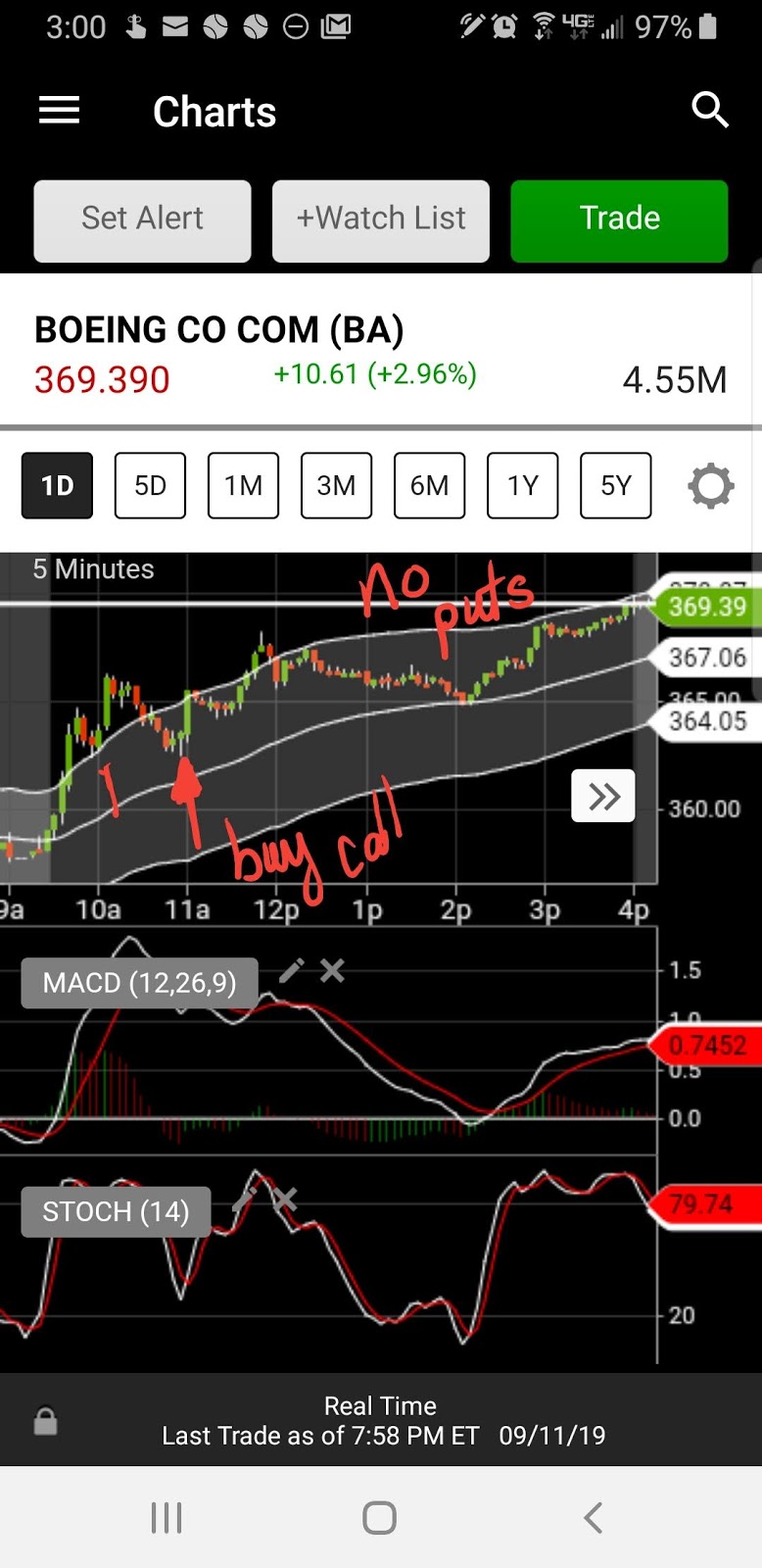
Stocks will bounce off of a resistance level either on the upside to signal a move downward or on the downside to signal a move upward. Some days, mainly on Tuesday's, there is a V movement. It might happen early or midday, but either way is the harder one to trade because it doesn't double test the spot it moved off like a typical day. Sometimes this bounce doesn't happen until late in the day and sets you up for the remainder of the week. Boeing is great for having limited downward movement and making a clear bottom before moving upwards for most of the day.

Breakout

A stock breaks out when it has a sharp movement followed by additional green candles in the same direction. When there is a breakout, it is important to wait for a movement in the opposite direction before trading in the direction the stock wants to go. You should expect 2 more sharp upward movement with minor pullbacks after you enter.

Whether you are trading calls or puts, on stocks or ETFs, it is important to get the direction correct. One stock is independent of others and just because one goes up in a sector, doesn't mean they all will. The opposite is true about downward movement.

Do not get greedy!!!

Take your profits, but don't be alarmed if there is a retest when you see your option prices go back to where you bought it. If you picked the wrong direction, get out quickly to trade another day. Do not trade too many different contracts that make it difficult to keep tabs on and end of losing more money. Practice the KISS method. Keep It Super Simple. It's OK to go small until you are comfortable with your decisions. Small wins are always better than a loss. Huge losses will have you finding another career quickly.

Let Do This!!!

Thursday, September 5, 2019

Day Trading Focus

I would like to own the job title of day trader. To be a successful day trader, you must focus on keeping your losses small and letting your winners run. Unfortunately I have failed to accomplish this. I have allowed myself to be impulsive in a number of ways including:

  1. Buying options too close to open when the direction is not clear.
  2. Buying call options on green candles and puts on red candles. 
  3. Buying in the opposite direction with the first inclination of change.
  4. Being greedy and expecting to sell where I can get ahead for the day.
  5. Expecting continuation of a sharp movement when the there are signs of a reversal.
Buy low and sell high is the goal when investing in the market. It is near impossible to do that when you buy calls at the top of an upward movement just as it is near impossible to be profitable when buying puts at the bottom of red candles. Most large green candles are followed by red candles and vice versa. It is important to wait for confirmation when buying options. When there is a sharp upward movement after a large movement downward, you must wait to make sure it is not done going down. That might have been your opportunity to buy put options expecting more downward movement. The opposite is true when there is a large upward movement that there might be some downward movement on the way up to a higher point which might present an opportunity to buy calls instead of hoping a put option makes sense.

FACT: If is it the right opportunity, you will be given the opportunity to take advantage of it or it was not the right opportunity. Break even is always better than a loss.

This fact is especially important when buying options near open. At open, there is the most uncertainty for the day and therefore the price of options are the highest. Fear of missing out is very high when trading options but patience is what makes profits by finding the right entry point. Without the right entry point, you are setting yourself up for a loss or break even at best.

Change of direction of a stock might happen once a day or not at all. If a stock opens low, it most likely will not go lower without a test higher. And if a stock opens up, it most likely will go down some before going back up. That first movement might be sharp or it might happen over an hour. Just because a stock acted a certain way, does not imply that another stock will react the same way with similar movement. 

Taking Profits
Being profitable is the key when doing anything. With the stock market and trading options that go to zero, profitability is a must. Many times we set a limit order after entering a position and that limit may be too low or too high. When you have incurred losses, you have a tendency of setting the limit higher than the stock will move in the day. The top of a movement in a day is typically very clear as is the bottom. The top or the bottom of the movement rounds out and the indicators look like it is changing direction. Don't rely only on the indicators only as many times the MACD may show a change before the rounding out occurs.

I believe I covered all of my points. This might not be a good read for someone who is not an stock option trader. I have been depressed and frustrated for so long trading incorrectly. Discipline is the key to being profitable. Typically there is a trade a day that will double or even triple your money. You just must be patient and allow it to present itself. It may not be in the movement that the day starts, but don't expect to see a change of direction because some days it doesn't change for the whole day. 

This might be more of a message for myself, but I am done being depressed and working out of fear. I am angry at myself and determined to do what is right before it is too late. Focus is key along with patience. If it is to be, it will present itself. 

CARPE DIEM!!!


Sunday, July 21, 2019

Profiting Huge Off $0.20 Moves

So many times I try to find the ones that devil, but many times you might miss your entry point, got in too soon, or got out too soon. Notice I left out got out too late. The goal is to take profits quickly, you should never allow yourself to get out too late. But many times the problem is you got in too early.

In the situation where you got into early, is often times better to take the loss where it's at don't worry about dollar cost averaging to make it better. Moreover if you do happen to benefit by dollar cost averaging and buying more when you do find the proper bottom, then the inflection point where you bought the first group at is probably set at the correct price and where you need to exit from the correct entry point. That sounds like a lot of mess, so let me give you an example.

Today JP Morgan appear to have topped around 114.70. I'm in money by buying 115 strike puts for $0.60 each. I made sure I sold them when JPMorgan got down to the point that it had hit in the morning around on 114.20 at which time I sold those for $0.95. So that was a quick profit a $350 minus commissions. So JP Morgan went back up close to that earlier Mark of 114.70 when I bought the same put options for $0.60. But there was a problem in that JP Morgan wasn't done going up.

JPMorgan topped in the afternoon at 115.07. at this time those put options were worth $0.38 a piece. So I bought more. And I had a large amount with intentions of selling at $0.60. It appeared that JPMorgan stopped at 114.68 so I exited the position at $0.56. my average cost was $0.52 on 50 put options for a profit of approximately $130. That certainly beat being down $700 in that transaction.

That would have been mad if I didn't take that profit and JPMorgan went straight back up. It did go up right after I'm foot that profit however it did go down further and those put options would have been worth $0.68.

Tuesday, July 9, 2019

Many Opportunities to Profit

I typically narow in on one or two stocks daily to profit from options. I feel it is best to know a stock so good that you recognize patterns that occur with it on a daily basis. I like using JP Morgan, I quit using Alphabet, Verizon is a fun one to make money on daily, Boeing is another one that moves and looks predictable,... I could go on and on. You can make money with options based on news for the day too.

Apple

Apple got a justified downgrade today based on limited device sales moving forward. That only makes sense if their service revenue is based on products that you get free other places and I could go on from there, but the point is Apple was set to open lower and probably fall further today. It failed to move up at open, so it was profitable to buy put options with a strike price of 200. You would have made a nice profit if you sold them when it reached 198. You could have made some money with 200 calls if bought at the bottom and sold when it peaked around 200.34. I did not investigate the options on it, but should have. See my chart to the right.

Boeing

Boeing has continues to have negatice news as a result of the grounding of the 737 Max. If somethinng makes the market negatice, Boeing likes going down with it.
Boeing had some nice movement up from the opening price, but failed to go hgher on the retest which would have been a great opportunity to buy put options. Call options could hav been purchased at the bottom, but it most likely was not going to reach the morning highs like JP Morgan.

I strongly believe and found that holding an options day trade for more than 90 minutes creates a losing position. 

JP Morgan

JP Morgan opened lower from Friday's close. It found a bottom at 112.50 and shot up from there. It came within penny's of break even for the day. If you bought 114 call options when it wsas at 112.50 at .35 and when it made it close to break even, you could have sold for .55 at a nice profit. At that peak, you could have looked for a place to buy 113 put options and wait for it to come close to the morning bottom.


Timing Summary

  • Apple
    • downside 25 minutes
    • upside 1 hour and 20 minutes
  • Boeing
    • downside 1.3
  • JP Morgan
    • upside 20 minute
    • downsie: from 11:20 to 3:05

Summary

It doesn't take all day to day trade. The key is to recognize when price is going to be spring loaded in one direction or the other, Do not expect it to continue throughout the day. Take profits quickly and do something else for the rest of the day.

Hopefully my blogs show you that there is money to be made with the market, but hopefully you understand there is a level of risk and if you don't time your entry and/or exit points correctly, you may be luck to break even or escape with a small loss.

Be paitent
Take quick action
Prepare to exit quickly if you are wrong
Prepare to exit quickly if you are right

And most important, sign up for a free papertrading account with Think or Swim, ETrade or Schwab. Learn the strategies and don't waste money.

Saturday, July 6, 2019

When to Take Profit and Run

The market moves up over time, but during the time, there are many little upward and downward movements. Many times there are more downward movements than upward movement. Some say the market takes the stairs up and the elevator down. There are opportunities in both directions and sometimes the same day with the same stock.  It might not be profitable to play both directions as you might miss an entry or exit point killing profit.

When you do have the right trade, it is important to take your profit quickly as you
can not assume the stock will reach a similar level later in the day. Some of the most profitable trades only take 15 to 20 minutes as was the case with Apple on Friday. I was expecting a quick drop as it ran into resistance on the upside in the morning. I made the perfect entry as you can see on the first chart.

Expecting further downside instead of reading the price movement, I did not sell on time. I held until it turned into a slight losing position. After looking at the total picture, I don't know what I was waiting on since the put option actually doubled in value in that short time from 10:20 to 10:40am.

You can't expect it to go up for ever and you can't expect it to go down forever. 

There are signals that indicate a stock has made it's full run up or down and will change positions. This goes back to the point in my blog the other day in taking your profit and don't look to give it back. The house always wins in the stock market too. Your broker charges a commission and not a percentage of gains or losses. Maximize your money, because they are going to make money either way. The longer you trade successfully, the more money they make which is a good thing as long as you are making more money than you are paying them. When you invest properly, you should always make far more than what you pay them.

Reflection

Friday is the same day I made the great day trade on the stock that broke out. I knew that was going to be short lived and should expect other trades that make sharp movements to be short lived too. Apple moved just like that stock I don't care to remember the ticker symbol of with the exception that Apple moved in the opposite directions.

Sharp movements will have some spring back movements from the bottom to the
point they might not revisit that bottom. Based on the signals, you could have bought in the opposite direction with call options on Apple and I would have bought call options that expire next week instead of this week to allow the opportunity to hold over night if I wanted, but also because 205 calls were not going to be worth anything unless Apple broke well above 205 which was not expected at the end of a holiday week. And 202.50 calls expiring 7/5 cost too much. Therefore I would have bought 205 calls with 7/12 expiration date and here is the chart for illustration of entry and exit points.

The 2 charts of Apple are the same, just written up different. You can see how Apple took the elevator down quick and slowly worked up for the afternoon only to take another short trip on the elevator downward. One more chart I could have drawn up would have been when it capped at the top and made the movement downward. At the top, a 205 strike put could have been bought for around .20 and when it was at the relative bottom near close it was worth 1.11 approximately. There was a risky, but nice 5 to 1 return on your money in 30 minutes.


So Cheap You Buy the Stock

While watching my favorite day time show on CNBC, the Halftime Report, they ended with final trades. Brian Kelly sounds like a fool most of the time between his predictions of BitCoin and Roku, but Friday he said CRBC. I typed it in the chart and a large green candle appeared as you can see the chart to the right. Starting at 7.40-7.50 range was interesting to me.

I quickly bought 500 shares at 7.67 and it continued to run up as you can see in the next chart. I have see plenty of run ups like this and many times they hit a ceiling after a quick run. Sure enough that is what appeared to happen as it failed to go above 8.40. I quickly sold at market for 8.22 for a modest profit of $280 in about 10 minutes.

As expected, it slowly bled away for the rest of the afternoon to finish up at 7.85. Due to the rapid movement, low stock price, limited coverage, I would not recommend trading options on a stock like this. You could do it and probably make way more money, but you could also be stuck holding it into a losing position due to lack of buyers after you paid more than it was worth due to lack of sellers when you bought your options.

I attempted to buy put options on the downside when I realized it wasn't even going to retest the peak. When it was trading for 8.10, I bought 5 7.50 7/19/19 put options with a bid of .05 and ask of .10. At market, the order filled at .10.

I then placed a sell order with a limit of .20. The options bid went up to .10 and the ask went to .20, but came down to .15. By the end of the day, I sold at market price for .13. Not enough profit to really be concerned with considering the risk.

Without research, you might be asking why didn't I buy $8 strike put options for next week or even with a $9 strike price. The first expiration date available was 7/19/19 and the strike prices were 5.0, 7.50 and 10.0. Given the limited options available, you know the volume is not that high. Sellers are in control on the way up and the buyers are in control on the way down.

This strategy is used by day traders and penny stocks. It is not practical if you don't have the cash to pull it off. It is important to have some cash available when opportunity arises. I had the cash available to buy 1000 and probably should have done it and would be up $560 in just that trade. If you only bought 100 shares, made your entries as I did, you would be up only $56.

Opportunities like this happen almost every day. You just need the right scanners, or chat rooms with someone recognizing it as it happens.


Wednesday, July 3, 2019

Better Entry and Exit Points to Profit

When day trading options for profit, options are typically the most expensive at market open due to time until expiration is the greatest the whole day and uncertainty in direction equals a higher premium. The stock that you are watching could move in the direction you expected and the option probably won't be worth more because the directional movement made up for the loss of time until expiration and uncertainty.

I typically trade options on JP Morgan, but today I also attempted to trade options on Tesla and Apple. I am writing this blog as a learning lesson of patience to avoid doing what I did today and make more consistent profits moving forward.

Tesla
Tesla reported record deliveries in the 2nd quarter of 2019. This should have been expected as Elon Musk stated in the 1st quarter numbers were deflated due to many of  the deliveries not making it until the 2nd quarter. Either way, the stock shot up nicely in the after hours and fell today during the shortened trading day. If you bought put options with this expectation near open, you would have been disappointed, especially since the stock did not move substantially lower. Please refer to my first chart:


This provides the greatest example of why you you don't buy options near open. Looking at the next chart, you had to wait only 30 minutes until 10am to buy the put options and you would have had a better target of 235 strike price. I even drew on the chart where is the best place to sell them.

Hindsight is 20/20, so it is always obvious when looking at the chart after the fact. The key is to see the chart, wait for the retest to buy your options and have your defined stopping point in mind.


Apple
Apple looked interesting today and with the drop in JP Morgan, I was expecting Apple to have a bigger drop towards the end of the day and I was wrong. As you can see on my graph, there was a point where it could have gone either way and I was expecting it to go down thinking the upside movement was exhausted. I think I stated this already, "I was wrong."

The break in trend was going to determine the direction for the afternoon. It broke to the upside. Since we can not read the mind of the market without our artificial hindsight, we must wait for the breakout, wait for the retest and then buy call options. I am quite proud of how I have drawn on these charts today and hope that I can be more patient to be able to recognize the pattern and profit larger rather than making the wrong decision.

I hope these help me do better and help you as well. Making 300 to 500 a day can be done easily if you are patient, wait for the right opportunity and get the direction correct.

Holding Until Tomorrow Rarely Works

In the second half of my blog yesterday, I discussed buying Verizon call options when I realized the shares were at a short term floor. Yesterday I also noticed that JP Morgan was at a short term ceiling at $114. I bought put options on JP Morgan yesterday for just under .60 on 10 113 July 5th expiration. I didn't sell when I should have when the options were trading for .85. Instead I held the options over night while JP Morgan closed at $113.80 on Tuesday.

This week is a shortened trading week with the markets closing at 1pm on Wednesday in celebration This is why I title my blog "Day Trading with Options." Don't hold options that expire in the same week over night because you will be disappointed more times than profitable.
for Independence Day on Thursday. The US markets will reopen on Friday, but holding options long that expire this week is investing suicide and here is why... Those 113 put options closed Tuesday at .47 while the stock closes slightly up at 113.80. On Wednesday, JP Morgan opened near 113.20 and those put options went down to .32. I did not panic and decided to wait and target a selling point near yesterday's high. I placed my limit order to sell at .80 and it got hit while JP Morgan stock price dropped to $112.30. Not only was the option out of the money yesterday when it traded for .85, it was 1.20 higher than where my options sold today.

Typically, you may buy back the same options you  had the prior day at a lower cost even if the stock moves in the direction of expectation due to the loss of time until expiration. 

This brings me to my 2nd point of the day... Many times we sell at the right time and made a profit for the day and we are looking for something else to buy. This is one of the biggest things that hold back traders from staying profitable on the daily basis. At the time we sell, it doesn't mean that the stock you were following is going to reverse position and it doesn't mean that something else is going to reverse position. When a trader does this, they typically are not buying at the right time and set themselves up to take a loss. Then because we got in at the wrong time, many traders will hold this losing position too long. Stops must be in place to exit when the trade isn't going your way.

Don't buy something right after taking a profit.

And finally, I realized something else yesterday when looking for the right selling point to take a profit in your option trade. You can use a similar method to find the right entry point to buy your option contracts. Typically, I like to look for options that I can double my money in one day based on the same stock movement for the day. You can actually look at the high price of the option that you are looking to buy and base your entry point far below as much as half. This way if you enter at the right spot, you can expect to exit at a profitable spot.


Tuesday, July 2, 2019

When holding a Day is Bettter

I try to keep my trading more simple in hopes of reducing errors and maximizing profits. I made a bunch of money trading Alphabet (GOOGL) in the past, but have lost much more. I appreciate sticking with stocks that move both directions in a day most of the time. This is true most days with JP Morgan. JP Morgan runs up, comes back to where it started the day, runs up again and comes down again... and might finish up.... or down. If you are disciplined, you can make money trading the options of JP Morgan.

Daily Pattern Trading

The really cool thing when trading options is that you can get a similar price after it has made part of the move in the direction you are expecting. For example, JP Morgan traded around $114.50 Monday morning. At that peak, you could have bought a 113 strike put with the expectation of downward movement for .50. It went down and then it retested that peak when it was at $114.20. During that second peak, you could have bought the same put options for .50 again. JP Morgan then went down near where it started the day around $113.30 and you could have sold those put options for over 1.00.

Today was similar as JP Morgan shot up to $114.20, came down and back up to
$113.92. At both times you could have bought the 113 strike put options for .50. Near open they were worth .79, so you must use that as a reference point where you wold need to consider getting out. Please see my  illustration of JP Morgan for 7/2/19. If you would have bought 10 of those put options for .48 ($448 cost) and sold them for .80 ($800), you see you would have profited $350. That is not a bad day job!

The problem we get is getting greedy. When there are no catalyst involved that could push the stock lower, we don't need to expect it to go lower. Take your profit and move to trade another day. I wrote that because that is not  what I did. I should have sold at .85 and would have been happy, but I was already unhappy with myself for buying at .61 instead of being disciplined and placing my buy order for .48. It would have been executed.

When To Be Greedy

If you follow certain stocks, you know they trade in a range. Certain stable companies get a little over sold and then get a huge push the next day. It happens with more stocks than you think if you pay close enough attention. AMD comes to mind and even IQ has made it to $18 before moving sharply up to $21 in a day. Verizon is more solid that those and their options are cheap.

Verizon has sold off from the $58.20 mark a few times in the past 9 months. Most of those times it finds a level of resistance on a Friday. It moves lower on Monday, but not by much. Then on Tuesday it spikes up over $1 to over $58/share. There is a safe way to play it and an aggressive profit spiking way to play.

On that Monday afternoon, you could buy $58 strike call options 2 or 3 weeks out. This would be safer because you do have time on your side to wait for the gains. I bought July 26 $58 strike calls yesterday at .28. I placed my sell order today as it was going up to get .50 and they sold while finishing the day at .68 which is more than 2 times your money.

I am aggressive too, so I bought $57 strike calls when it was trading for $56.80 on Monday at .32. If I were more patient and noticing the pattern more clearly now, I would have waited or placed my buy order with a limit price of .22. At that price, I could have bought 15 and it spiked this morning above $58 and could have sold those calls for over 1.00. That's 5 times your money in one day!!!

The subtitle is when to be greedy. I write that because I profited on this trade twice this year and both times I sold at 2 times my initial investment instead of 4 times minimum. I hope to do better next time.

There is a possibility that it runs up higher over the next couple of days, but there is also a possibility that Trump says China lied and more tariffs are coming just to tank everything quickly.

I am quite sure that 10 years from now, there will be a huge investigation on how President Donald Trump manipulated the stock market by telling certain personal stock traders the news in advance to buy puts on the market and calls when he had favorable news. The scandle will discuss how much money his family profited by this manipulation. Then right after he goes to trial and is found guilty, he will pass from heart attack or something. It just looks like a pattern of evens similar to watching certain stocks move in the market.

Saturday, June 29, 2019

Patient Day Trader Follow Up

The past 2 days I have analyzed some day trades for profit in my blog. I specifically looked at trading JP Morgan call and put options. I have used Charles Schwab for trading in the past couple of years, but am transitioning to E-Trade as they have more powerful tools to use. E-Trade allows you to actually view the charts on the specific options. Obviously you can not trade options based on stocks without having an idea of the stock movement and direction or you would not know if you should buy a call or a put option.

x

Initial movement on Wednesday was to the upside. I did not like this trade because there was no retest before just shooting higher. If you timed it perfectly, you could have bought the 109 calls for .7 and you had better have sold them for just under 1.00 or this trade would have been an ugly loser quickly and would not have broken even.

If you were the patient investor, you could have waited for a great opportunity with better signs in the afternoon when JP Morgan peaked around 109.30 and you could have had a nicer chart of the option to base your trade.

Now when you look at the chart of the 109 put on JP Morgan, it was at it's lowest point at the morning peak. What was really interesting is the value was the same later that afternoon although the stock was lower than the morning peak.

As I mentioned in yesterday's blog, the Pivot Point on the graph designated 108.65 as the proper exit point. That was where the put was it's highest value in the afternoon of .70 which is a nice profit from .4.

Thursday was similar to Wednesday. There was morning move up followed by a sharp move downward. From the bottom, it moved up, but not to the level it was at in the morning spike. I gave much more detailed writing on this chart of the 109 put option on JP Morgan.

Friday was a little scary, but you could have made bigger money if you were working with options that expired that day as long as you stay at the money on purchase at time of purchase. 
  • JP Morgan opened at 111 and spiked up to 12.56 approximately. At that time the 112 put options that expired 6/28/19 were worth .16 to .19. If you were to buy them there, you could have held them for it to come down to where it started at 110.97 and sold them for 1.05. 
  • After bouncing from 111, JP Morgan ran back up and peaked at 112.22. At that point, those put options were trading for .18 again. I bought 13 just under .22. 
  • JP Morgan moved down slowly, jig sawing from 111.90 to 111.75. At that time I received a call from Charles Schwab Derivative desk telling me that I better sell them or they will be forced to by 3:30PM. 
  • I was thinking I should be able to sell them for at least .60 and triple my money. I got nervous and didn't want to sell for a loss. I placed my limit sell for .38 and .40. It just appeared that it would not go down further. I lowered my limit to .35 and it was still teetering between 111.72 and 111.88. I lowered my limit to .32 and it got sold pretty quickly. 
  • After that JP Morgan dropped quicker. I saw those put options were worth .4, then .5, then .6 and finally .85 when JP Morgan reached 111.12. At this point, around 3:30pm, JP Morgan shot straight up for the rest of the afternoon. Those put options were worth .2 by the end of the day. 
That whole process was a little nerve racking, but I felt like I did fine. I might not
have felt as pressured if I didn't receive the call from Schwab telling me to sell the options before they do it for me. I could have made decent money if I were using options expiring next Friday, July 5, 2019 as shown in the chart to the right with 112 put options.


The next chart shows what the price movement would have been like if you were to buy 111 put options expiring July 5, 2019. The profit was not as big trading these that were just a little out of the money and were never in the money during Friday's trading session. This offers nice reference that buying out of the money options even with a week until expiration if not as profitable as at the money with this price movement. 

I hope you found this blog interesting and informative. This information is based on what I saw and I like to reflect in hope of perfecting my entry and exit points throughout the day for making profits buying and selling options. They key is that you can expect to buy at the same low price or lower, but you may not get a higher price to sell when it is exit time. 

I like to describe stock movement as a rubber band. If you stretched out a rubber band and plucked it from one end, the waves would be larger near the pluck, but in time smooth out to come back to a neutral position.


Thursday, June 27, 2019

Patience Leads to Profit When Day Trading

Money can be made on the market going up and down daily especially with options. There were sharp movements today with Boeing, JP Morgan and Home Depot. I tend to stick with these few stocks because they have decent daily movement and you can profit nicely with as little as $500.

Boeing

Boeing had more news over night as the FAA found another problem that needed to be addressed with their max airplane before being allowed to fly again. The stock moved sharply down almost 10 points from Wednesday's close. It popped at open, went down, came up a little and retested that low before rising up for most of the day. It had a sharp move up around noon as shown in a 1 minute chart.

What I have noticed it that when it has a sharp move up, it make get another move higher, but will have a sharp move downward by the end of the day. That is exactly what happened at 3:45pm when it was announced that Southwest Airlines is canceling their order of the max jet. This is too late in the day to expect to happen, but it has shown to happen multiple times in the past month. You could look at Wednesday's chart when it was moving up and then sold off in the afternoon. If only you held those afternoon puts until Thursday. But we don't do that when day trading options because it could have easily had good news that moved it up to 390 similar to what happened with the banks today. I drew up some notes on a chart for you to study.

JP Morgan

Today's movement with JP Morgan was similar to yesterday, but quite different in the pattern. To start the day, JP Morgan opened higher than yesterday's close. There might have been a moment near open when you could have bought calls, but I don't like it because there was no guarantee that it wasn't going lower as a retest. It ran straight up, topped and sharply moved downward. The move offered no retest of the peak and no retest of the lower areas as it moved sharply up from the bottom. I did not trade these movements because they did not show good entry points for day trades.

The afternoon high was not as high as the morning, but it did show that it was peaking around 109.30 as it moved downward before coming back to that area. When it was at 109.24 I bought 109 puts at an average cost of .43. I went to the bathroom while monitoring the stock on my phone and saw it went slightly higher for the second peak at 109.36. Unlike yesterday, I did not lose 10 cents an option this time. This was true mainly because I bought 109 puts that were closer to being in the money compared to yesterday when I bought 108 puts that were still 50 cents out of the money in the afternoon.

I was not worried because every time JP Morgan touched 109.36, it went down quickly and did not hold that price. After the second time, the stock started falling. I bought 3 more when it was at 109.31 at .41. I was hoping to be able to sell these options for .8 or .9, but realizing that they expire tomorrow, I knew the premium was going to decrease based on the less time to expiration. I decided to target my exit based on the morning drop and utilizing the Pivot Point of 108.65 from my trading software that displayed the Pivot Point.

Sure enough, JP Morgan made it to the Pivot Point of 108.65 which was slightly higher than the morning low. At this point my put options appeared to have topped out at .70. I placed my limit order for .75 and lowered to .72, but the stock appeared to make a reversal, so I finally got it sold for .69 which created a profit of $320 on my 13 contracts.

That might have been a good point to buy calls for the next day if I did not mind holding options over night. But that is not what I do. JP Morgan moved sharply to 108.90 before closing around 108.80 and those options would have been worth around .60. After the close, the Federal Reserve announce the results of their stress test and JP Morgan along with all of the other US banks moved upwards big time. JP Morgan moved almost 2 points higher. They also announce dividends and stock buy backs.

Friday Expectations

As we enter the weekend of the G20 summit and escalation of trade meetings, the market should open higher on optimism and on the back of the great bank news. It would be awesome if the market would close on the highs of the day, but given that it is also that last day of the quarter, we might see an afternoon sell off that drops us just above the flat line. We might not have a sell off, but just because Alphabet is near it's low point for the week doesn't mean it will automatically head higher and stay there. Buying expiring options is dangerous on Friday, but as long as you are making sure they are in the money, you can make money doing it. Buying options for next week is a safer bet and does not require you to buy so close to being in the money to make profit.

Wednesday, June 26, 2019

Make More Money Waiting

Making money with the stock market in the long term is a buy and hold strategy utilizing stocks with great dividends like Verizon. When you day trade, you must wait for the right buy signals. If you are not disciplined, you will be buying early and late and selling early and late. When you see certain patterns, you have the tendency to buy expecting that pattern based on the day of the week or just plain wishful expectations.

Not waiting does not only shorten your earning potential, it can cost you for your day profit and create a loss you can't dig yourself out of for the day. Let's break down expectations and timing utilizing JP Morgan activity for the day.

Initial Move for the day

The first movement of the day may not be more than a reaction in the opposite direction from the prior day's movement. If this is the case, the theme is likely to continue from the prior day. Alphabet (GOOGL) was a perfect example of this today.

On the other hand, some stocks like JP Morgan go up and come down in the same day which ultimately create net gains for the day. Today looked similar to yesterday for JP Morgan as it moved sharply up from market open. When that happens, you wait for the pull back to  a near open price to buy calls for the upside. On my chart drawing, I mark it with a yellow "A."

Now you are going to let this run until you get 2 consecutive red candles which designate resistance when looking at your daily chart with 5 minute intervals. This is not the time to sell as it must retest the top. When it does, it typically goes slightly higher. You can sell at this mark or place your trade when it retest that mark again. You will know it is a retest when it reaches the same spot, but the stochastic lines have peaked at a lower mark. The second way is based on peaking in the price chart with space between the top of the Bollinger Band (B).

Secondary Movement of the Day

When you have noticed the top has formed. You locate the first out of the money put option and buy at or near the lowest price of the day. Once you are in on the opposite direction, you must be patient and withstand upward movement as long as it doesn't move dramatically above the pre-established ceiling for the day.

Now to determine the exit of this 2nd position of the day, you should look at where the area was that you bought the call option on the first movement of the day. It is almost safe to aim for the point to take your profit and get out. There are many days the reversal is stronger than the upward movement. It is nice expecting it, but if you enter and exit at the right locations, you make profit and are not holding like I did today just to break even.

Further Notes

The strategy works with many stocks, but not every stock has 2 sharp movements in the same day. You can say that most stocks move in one direction and give part back towards the end of the day, but then there will be that one day that it doesn't give back towards the end of the day and you were expecting it. The key is do your research, know your favorite stock tendencies, get in and out to take your profit daily.

Why I Broke Even and Didn't Profit Today

I bought my 8 initials calls at the right moment today. I freaked out with the 2nd large red candle instead of waiting for the retest as I have seen almost every day. Although the stock was higher than where I bought the calls, because the calls were out of the money, I ended up selling at a break even minus commission. I would have been up over $120 if I were patient and sold at the 2 peak.

On the secondary movement, I bought my puts before waiting for the top to form. I have made this mistake before, so you would think I would have learned, but this is why I am writing this blog. No matter if anyone else reads it, I expect it to create a more powerful memory to act appropriately in order to profit off small movements rather than break even or lose money.

So I bought these 108 strike puts in a market order at .48. If I had waited, I could have placed my order to buy them at .36 and would have bought a third more contracts. I did buy more at a lower amount, .44 which is still not .36. I did not panic although I did have 15 contracts with an average cost of .48 that were worth .36. My account was negative $200 at the worst part.

As I mentioned, I did not panic and knew the downward movement was due with all of the red candle following the peak of the day of 109.30. It moved in my direction, but unfortunately the highest these puts were worth today was .54. I did not sell there because I thought it might fall move sharply towards the end of the day. I was greedy and disappointed based on not buying at the right time. If I had bought at .36, I could have sold at .50 with a different of .14 times 20 contracts for a profit of 280 minus commission. Instead I sold at close for .48 to end the day break even minus $20 in commission.

Day Trading with Options Fresh Start Rule

Part of day trading with options is closing out your position by the end of the day. Each day goes by, the options are worth less if the price of the stock opens tomorrow where it closes today. The only time the option is worth more is when it move substantially at open the next day. Most of the time, even if it opens in your direction, you can buy those options for the same price you sold them the prior day. Therefore the odds say, you are more likely to lose money holding options over night. Like anything, holding options over night could work one time, but more times than not it will not work in your favor.

Tomorrow is a new day and as long as you did not buy options based on hope instead of indicators, you can make tomorrow twice as good as today.

Thursday, June 13, 2019

Target, Walmart or Amazon?

Watching one of my favorite shows this afternoon on CNBC, they played a game, Would you Rather with Target, Walmart or Amazon. I found their discussion interesting as many of them picked Amazon, or Target over Walmart. Since they didn't ask me, I thought I would write my 2 cents.

I feel there is one winner as the other 2 are trying to catch up. The analyst on the show stated that Amazon will try to squeeze profits from Walmart and Target. I don't think they account for the high over head cost Amazon has between delivery, warehouses and employees to run those locations. Amazon clearly doesn't have the overhead of running a retail location, but that is nominal when you consider a couple other factors that retail locations allow.

Retail locations allow people to feel, touch and try. You can't get that experience online. Retail locations also have the ability to take cash and food stamps that you can not do on Amazon's website. When people use other forms of payments including food stamps, many times they buy other things in addition to food. This ultimately leads to the realization that Amazon does not cater to low income families with make up a large percentage of households in the United States.

Amazon might be a better play if you consider their business web services and video services. However, Amazon has increased the price of their Prime membership to increase profits while shrinking delivery times by a day. While Amazon collects a monthly fee for their services, Walmart provides the same delivery service with no membership.

Each company has spent money in the past couple of years to improve. Amazon bought Whole Foods for a retail food presence that also expands their Prime Membership reach for great synergy as Whole Foods caters to a more affluent customer. Target spent money to improve their stores in the past year, but I didn't really see a difference. Walmart on the other hand spent money to acquire Flipkart which is the leading online retailer in India, the 2nd largest country by population in the world. So each company has spent money to expand their businesses rather than wasting on share buybacks.

From the investments the companies made, I believe Walmart's purchase of Flipcart was the most aggressive that will benefit them the most in the long run. Walmart already has a great online presence so adding Flipkart jumped them in front of Amazon in India. Flipkart's synergy is great as Walmart's website is a marketplace where a variety of sellers also sell products like Amazon.

In addition, Walmart also has it's own brand of products they sell for a higher profit margin to comparable name brands on the shelf. And Walmart even sells low cost value based items in that are similar to what you could get at a Family Dollar, Dollar Tree or Five Below. I do realize that Target does similar things to Walmart, but ultimately Target appears to be a different version of K-Mart which eventually disappeared.

To avoid the fate of K-Mart, Target needs to improve their online presence to the point someone wants to use their app to search for things first like Amazon and Walmart. Target must create a marketplace for other sellers so their may profit from seller fees. Target must also improve their value based presence. To me, there are too many things that Walmart already does well that Target isn't in the same league as Amazon and Walmart

All factors considered, I believe Walmart is the best bargain for your investment dollars of the 3 with Amazon in a close 2nd due to their server business. Amazon could get in front of Walmart if they were to take advantage of a major retailer going out of business like Sears or JC Penny's who have locations and their own brands.


Friday, March 15, 2019

Tesla Sell the News - Model Y

Tesla announced their new Model Y last night. This new model should produce great profits for Tesla for years to come and will probably be produced much faster than anyone expects because the doubters remember how long Tesla took to mass produce the Model 3 and they are wrong expecting the same for the new Model Y.

Regardless of Tesla's future, it always trades the same on Friday's after a funky Thursday release of news whether good or bad. On Thursday, Tesla's stock ran up a little, but pretty much ended the day unchanged. The market didn't like the release of the Model Y despite the company almost did it perfectly if Elon Musk didn't stutter so much throughout the presentation. So let's break down how it trades.
Tesla opened down from Thursday's close and fell down after that. It fell quickly, had a small tooth up and fell further down. If you didn't get out of your Put options there, you would have to wait until 3pm to get out for close to the same profit. After the bid drop, Tesla moves up about half of the move before falling for the rest of the day. I would not recommend buying the morning bounce unless you were willing to sell it quick when it hits the morning top.

I recognized this pattern as it has happened many times in the past year with Tesla. I let my emotions get in the way and didn't pull the trigger properly. I bought near open, sold afraid of the bounce up, bought again when heading down, didn't sell quick enough at the morning bottom and finally I was not patient enough to wait for the afternoon bottom.

So since there is a downward Friday pattern, there is a following week pattern too. Typically, you could buy a call for the following week and be happy on Monday as it is oversold for the same reasons why it gets bought the following week. As long as Elon Musk doesn't go Twitter happy next week, I would expect to hear some good news like Tesla has produced 5k Model Y's over the weekend. I would look to buy calls near open and sell on the upside and don't play the downside during the week. You should get additional opportunities to buy more calls at a lower price the next day. I don't like hoding over night on Tesla because you will get burned.

Obviously traders are not in charge of the stock of Tesla. Algorithms and computers are in control of the trading of Tesla. Day traders only add to the fuel, but don't determine what happens with the stock of Tesla. It is unfortunate, but I write this blog in hopes to help someone, but most importantly try to improve my own trading to avoid making the same mistake and profit by these moves. I should have been up over $800 from Tesla alone, but because I let my emotions weigh more than my knowledge of the stock, I was down $200 in my Tesla put options today.

Thankfully I did not make the same mistake with Alphabet (GOOGL) this afternoon. I got in a little early and when my Put options got in the money, I did not set my limit order and missed out on half of the profit. I am thankful to be able to trade another day and hope to be more patient every day and to go with the flow while not marry my positions.

Wednesday, February 20, 2019

Day Trading After President's Day

The market was poised to go up on Tuesday and it ran up for a quick pop before settling down. I charted Alphabet (GOOGL) as I waited for it to come down to 1116 when I bought 2 1135 calls at 4.6 each. They ran up to 7.2 before falling for the next couple of hours. Once again, I should have sold there, but didn't.

Alphabet went higher in the afternoon, but those call options were never worth as much as that early morning. Take a look at my chart below:
I turned off the trailing stop and sold at 5.27 because I felt the indicators were pointing to a reversal. It did reverse after going higher. I would have benefited by using a trailing stop order. I grade myself an A on entry point, C- on not utilizing a trailing stop and ending my trade earlier.

On Wednesday I took a different stance. When Alphabet moved up to 1129, I bought a couple 1120 Put options with a cost just below 5. It did move down and bounced off of 1125 where those Put options were worth 5.5. Then Alphabet moved higher, but never past 1131 and suddenly moved sharply lower right after I texted a friend saying I expected some downward movement this afternoon after 2pm. 

On that downward movement, my sell order triggered as I placed a trailing stop order to sell to close once the price hit 5.5 and the trail buffer was .5. It triggered so quickly and I missed out on almost 500 because it flew down to 1122 before bouncing up. At that bottom point it would have been worth 7.9. If I placed a larger buffer on the trailing stop of say 1.0, I probably would have received 7 or more.  I wish I turned off the sell order to wait fore post Fed announcement reaction.

After the Fed Minutes were announced at 2pm, Alphabet went down sharply to 1112 at which point those Put Options were worth over 12. This created 2 learning lessons:
  1. Place a larger trailing buffer to avoid too early of a close on profits when trading Alphabet. Better than placing a larger buffer would have been placing the trailing stop to trigger when Alphabet trades below 1118 or 1119. That would have captured the goal as it was where I say Alphabet trading down to.
  2. Be more patient and wait for a better entry point. I thought I was being patient, but I paid 300 too much for the options. I could have been up over 1000 by buying one additional Put Options.

Take a look at my chart below.
I grade myself a C on entry point, and a C on exit. Exiting for a profit is the goal, but I should have targeted the trading price of the stock to get to 1118 before entering a trailing stop and probably would have received closer to 1200 per contract.

Sunday, February 17, 2019

Day Trading with Paper Money

I have grown frustrated with Charles Schwab and their lack of comprehensive mobile trading software. I decided to try some alternatives, so I first tried ETrade over a year ago, so my period of discounted trades have come and gone. I did find that TD Ameritrade provides as many tools if not more than ETrade and they provide a free paper trading account.

With TD Ameritrades free paper trading accoun, I bought 5 Tesla 320 call options with February 22nd expiration when Tesla was traded down to 309 as it appeared to bounce off 309 about an hour earlier. I was feeling good about this trade since it closed at 311 on Wednesday.

In an account with real money, I was actually short (sold with expectation of profit by depreciated premium) a 280 strike Put Option with a March 1st expiration that I sold the day after Tesla reported earnings when it was at 307. I felt good about that strike price going to 0 because Tesla just bounced off 280 in the previous week and it didn't appear to want to move lower than 300 the day after earnings. The premium was still high because it was the day after earnings so I received over $814 for a strike price 27 points away!

As Tesla moved up for the next couple of days, the premium fell. When Tesla moved up to 324, this option that I was short was worth around $320. Tesla moved between 318 and 324 before moving lower on this past Wednesday when I bought back the Put Option for $226 as it appeared that Tesla was going to move lower. I decided that I took most of the time depreciation out of the option and would cover it so I could sell another one when Tesla moves lower.

More news came out after Wednesday's close that would negatively impact Tesla's stock price so I felt good about covering the Put Option that I was short on and hoping to find another time to sell the same strike option. That time came on Friday when the FANG stocks opened higher and moved down quickly. Tesla opened lower and moved up slowly. When shorts were in control of Tesla in the past, Tesla would move lower on Friday. This time it didn't want to move lower and kept trying to move higher.

When Tesla was at 305 on Friday, February 15th, I sold another 280 strike Put Option for $585 with a March 15th expiration. I like this expiration because it shows a level of recent support which means that even if Tesla moves lower over the next month, it will be affected by time decay on top of negative option movement since I expect Tesla to move back up to 320 in the next week.

Unfortunatly, I checked my paper trading account with TD Ameritrade after the market closed on Friday and found that the trailing stop order I placed Thursday afternoon for the 320 strike 2/22 expiration Tesla calls executed Friday morning at 9:33 am when Tesla was trading at 304.

I clearly would not have wanted to sell it there and creates a new learning lesson. Thankfully it was with paper money and didn't hurt financially.

LEARNING LESSON: Do not place a trailing stop with a GTC (Good till Cancel) ever without an additional trading condition like price. You may not place an order and not monitor it and expect to profit.

I still have more time with the paper trading account with TD Ameritrade and expect to practice with it more this coming week.

Monday, February 11, 2019

Schwab Needs So Much Improvement

After leaving the investment company that I was with for over 12 years and my father passing away, I decided I was going to actively managed my families funds. I have experienced some good and some bad as I started with Charles Schwab. Initially I was very impressed with the tools available through their website and trading tools with their computer software, StreetSmart Edge, and mobile application along with investing with artificial intelligent portfolios in ETF's with no fees. Unfortunately I have found the real truth elsewhere.

I have shared my experience trading with a friend. I recommended he use ETrade due to their tools and didn't recommend opening an account with Schwab. I decided to stay with Schwab so I can manage my mother's account and participate in lower transaction cost. Unfortunately Schwab has me very frustrated because their mobile application is horrible and does not provide the ability to use trailing stops. Only the full blown StreetSmart Edge, which is only available on a Windows 10 PC or a Mac, is capable of doing complete entry and exit strategies on the one platform.

I do have a Windows 10 computer that is awesome, but would like to be able to be free and not attached to it at all times during the day trading. I use my Samsung phone and tablet for doing work
and would prefer to use it for trading also. The mobile application is extremely slow and I have found using the mobile website to be better for some things. Charts are not practical on a mobile device through Schwab. I have had a tendency of using Yahoo Finance (not instant updates) or ETrade to view charts with indicators through the day when I am mobile.

When I am mobile, I have found that I can access my computer at home via a remote desktop application and use the StreetSmart Edge software on my home computer through my mobile device. This is not fun as my connection with the internet is strong for the most part, but may lose connection with my computer at  home or experience a lag that causes me to miss clicking on the correct button at the correct time. The mobile device only views a portion of the home computer's screen which makes it difficult to click when you are actually moving the screen and vise versa.

So the next step was to find a Windows based tablet or laptop that I could use for trading and everything else. Costco has a current sale on a Surface Pro 6 bundle with type cover and stylus bundle, so I took advantage of it. The Surface starts up very quickly and works great. When I logged into StreetSmart Edge, I loaded my saved layout after connecting to my TV as an extended wireless monitor. It was fast, but blown up!

I have 4 different company charts on the 2nd screen, but I could only see 2 and a half of the charts. On the main screen, the chart I have to the right was hidden under the account details and watch list. After further investigating, the TV was set to 150% and the main screen of my tablet at 200%. So I changed both to 100% and the display on the TV looked perfect, but the tablet screen print was so small I could not make much out. This was not working out too well.

In another attempt to try to make it work is using the browser version of StreetSmart Edge. I already knew that the it would not work in Chrome as I tried it on a Chromebook in the past. I also tried it on Firefox. It said that it works in Internet Explorer, so I figured it would work in Microsoft Edge. WRONG!!! This is really bad since Microsoft is trying to get rid of Internet Explorer for good.

On top of that, Schwab's StreetSmart Edge software is buggy. The later in the day, it slows down. I have called their technical support, got someone in trading who had to transfer me to someone in technical support, and then they want you to install a browser add on so they can look into your computer. They have backed up my StreetSmart Edge layout, wiped StreetSmart Edge clean and restored my layouts. This typically works better for about a day. After that it is slow again.

I have tried to find different ways to salvage my relationship with Schwab, but ultimately it feels like they don't want to be in a relationship with me as their tools have not improved and actually worsened. I have tried to make an egg into an orange and it has not worked. I feel insane doing the same thing everyday expecting a different result.

I don't know why it has taken me so long to finally come to the determination about wanting to leave
Schwab. I know that ETrade and TD Ameritrade have the tools available on all platforms that are available on StreetSmart Edge with very little to no lag time. I have an old ETrade account and opened a paper trading account on TD Ameritrade. I will contact Schwab first to find out what they are going to do to improve on the situation. I will then contact TD Ameritrade to see if I can negotiate lower sales commissions.

Profitable Options Trades on Friday

Friday marked the end of a long week of earnings. This also marked a year anniversary of when negative fluctuation began. We received the same news as last year from the FAANG companies of Apple, Amazon, and Google (Alphabet) where they produced strong earnings, but mentioned higher cost. This year it is different as we have a Federal Reserve that appears to be easing, trade war is simmering and stocks were far over sold in the last quarter of 2018.

Moving into 2019, companies started quickly providing earnings warnings. Apple was the first to do it on the first day of trading on January 2nd. They went down hard and shot up after that. Apple was the only one to actually drop after the warning. Skyworks went up after the warning and up further after annoucing lower than expected earnings. That doesn't make sense to me.

What also doesn't make sense in how Alphabet goes down either the day after announcing earnings and again for the rest of the week. Alphabet did report earnings on Monday, went down some on Tuesday despite falling hard on Wednesday and Thursday. I did see it bottom early on Friday and bought a call option expiring the following Friday. Check out my chart to the right.

Expedia was a big mover after reporting earnings on Thursday after the close. I saw it run up near it's
52 week high and when the market opened on Friday it came straight down. I noticed that it bottomed just above 129 by 9:45am to I bought a couple 132 calls for next week. I failed to sell them at the peak as I was greedy and expecting it to go higher. I would have been up 260 if I sold them when they were worth 4 a calls. I have that chart to the right also.

The third trade I took part in on Friday was Boeing calls. I bought next weeks 405 strike calls near open. I should have sold when it peaked quickly to take a quick profit because that is typically what Boeing does on a Friday. Or I could have bought a Put near the quick morning peak and sold it for a profit when it bottomed around 11:30am. That time would have been the best time to buy call options on Boeing as it went
straight up from there. I sold my calls earlier than I noted on this chart because I sold them at 1pm and did not expect it to go higher from there. If I held until close, I would have made the same profit as if I sold in the first 10 minutes of the day.

That brings a huge reminder to take your profits early and do something else for the rest of the day. The stock of your choice must go higher than previous morning high for your option less than 2 weeks out not to depreciate due to time decay.

/As usual, I hope this helps someone. I am still trying to refine my skills and be profitable in larger amounts every day. My main issue is buying too early and not waiting for a confirmation on the proper entry point. I did it on Alphabet and Expedia on Friday, but failed to do it correctly on Boeing which made taking the largest profit not possible since I got burned earlier when the MACD and the Stochastic Indicators peaked and I didn't sell.

IMPORTANT LESSON: Many times you can profit in less than an hour. You will not make more by holding longer. This is not a job and you do not make more watching it go down. You actually lose and will lose twice as much as you could have gained if you don't get out at the right time. Take your profit and run!


Friday, February 8, 2019

UGAZ and DGAZ will go to 0!!!


UGAZ and DGAZ were brought to my attention this past November by a friend. At that time, UGAZ
was moving between 130 and 150. I asked him if he sold when it went back to 150 and he said "No." UGAZ went down below 110 after that and continued lower. At this date UGAZ is sitting at 27. I bought some when it was at 44, more at 42, more at 40, more at 38 and sold half when it went back to 42, sold more when it went up to 62. Thinking it would go up, I bought as it was going down. I got out and gave up the gains I made on it. I then took a step back and evaluated UGAZ as an investment.

I saved a picture of UGAZ chart from BigCharts.com and if you look at where UGAZ began near 70,000 and you can see it went in a straight line down to 20,000.

Question: Where is the huge jump it had at the end of 2018?

Answer: It is so miniscule on this chart that is doesn't show up. You do see the volume shoot up because everyone was chasing the money and many got slaughtered being pigs.

For those who would like to know what is UGAZ:  UGAZ provides 3 times the percentage return of Natural Gas on a daily basis. DGAZ provides the inverse (opposite) of that return. So if Natural Gas goes up 1%, UGAZ goes up 3% and DGAZ goes down 3%. If Natural Gas goes down 1%, UGAZ goes down 3% and DGAZ goes up 3%. With that in mind, after seeing the ugly chart of UGAZ, you would expect DGAZ to be the opposite and shoot through the roof.

Initially, DGAZ did shoot straight up as UGAZ went straight down, but over time they have normalized and went straight down together. To understand this, we need to take a step back into the math class. Many familiar with investments understand that down 30%, then up 30% does not bring you back to where you started. Instead you are still down 9%. It actually takes a 42.85% positive return after a 30% drop to break even as shown in my calculator screenshot to the right.

Next we should look at the underlying asset that UGAZ and DGAZ is based on which is Natural Gas. A chart of Natural Gas is not easy to find, but futures on Natural Gas can be charted easily. If you bought a future contract in 2008 on Natural Gas for this March 2019 the cost was much higher than today. Futures are similar to options and carry a premium based on the time factor. If UGAZ and DGAZ are based on the futures, it only makes sense for them to go down when you compare them with the next chart.

Looking past the charts and thinking about an investment into an ETF (Exchange Traded Fund), most all ETF's are available to trade everyday AND have the ability to buy and sell options on them. UGAZ and DGAZ are not option-able ETF's. Looking at the charts you can see why when they go straight down anyone could make money selling calls and buying puts if they were available. As long as you traded them far enough out, but not too far you would almost be guaranteed money.

Based on the preceding factors, you probably understand why I come to the conclusion that UGAZ and DGAZ are not investments as they will go to zero. You are probably wondering why are they traded on the open market if they are so bad. Velocity Shares is a popular mutual fund investment company who makes money selling you on the idea that you can get 3 times the return of the underlying asset. If they collected $80,000 per share back in 2008, they have plenty of money to pay out as it is designed to go down. That sounds like a Ponzi Scheme to me! They are not the only mutual fund company that produces these types of products.

A year ago there was huge news on people losing money when the VIX (Volatility Index) spiked up. People got fat and happy since the volatility was so low for so long, they got caught off guard when volatility spiked since their ETF was invested in a multiple of the inverse volatility. Investments like this are pushed and sold appealing to people's greed factor. They are not good to put your money and are very dangerous. You should never invest in one of these if you are looking for something to buy and hold for the future. Please do your research before investing.

Profits Only, Please!!!

I have spent the last 2 years trying to figure this day trading with options thing out. I hit an ultimate low this past Tuesday and felt lo...